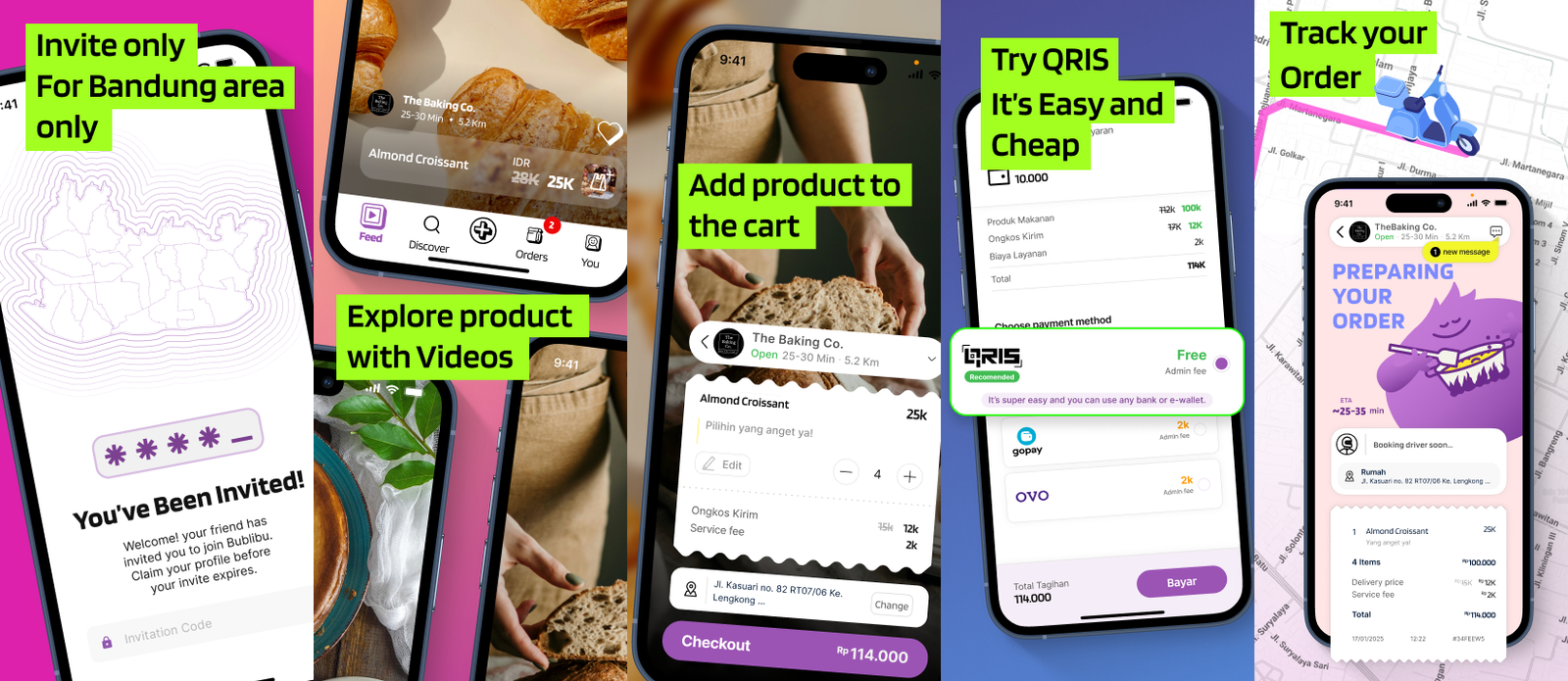
Fg01 1: Bublibu app release materials
Context & Overview
In early 2020, Bandung went quiet. Restaurants closed and offices emptied, but food didn't stop moving it just moved differently. The movement shifted to WhatsApp broadcasts from home cooks and a new wave of local courier operators who appeared almost overnight to fill the gap major platforms couldn't, or wouldn't, fill. By mid-lockdown, an entirely informal economy had emerged, with at least ten active local courier operators in Bandung alone, transacting outside every existing platform.
Bublibu started here. Not with a pitch deck, but with an observation of this invisible, parallel market.
Research Questions
Before writing a single line of code, we needed to understand the mechanics of this informal economy. Our product discovery was guided by three core questions:
- How might we provide home-sellers with structured marketplace features (discovery, tracking, payments) without crippling 20-40% commission fees?
- What are the specific friction points causing drop-offs in the current manual, WhatsApp-based transaction flows?
- Can an agnostic API integration with emerging local courier fleets serve as a viable, scalable alternative to maintaining proprietary logistics?
Methodology
To validate that this invisibility was an underserved market rather than a lack of demand, we focused on qualitative discovery.
- User Interviews: We conducted deep-dive discussions with active home sellers, including RumkayDago, Bia Kombucha, Ngombe Jamu, Bebek Setan, and Dapur Sedap Nikmat.
- Contextual Inquiry: We observed their current workarounds, documenting the messy, manual coordination between Instagram DMs, WhatsApp chats, and local courier dispatching.
- Ecosystem Mapping: We mapped the operational capabilities of local couriers (Ahsan Express, Paketin, Tiketux, etc.) to gauge their readiness for future system integrations.
Discoveries
Through our research, we separated the immediate user frustrations from the broader, structural market failures.
User Needs (The Micro)
Sellers and buyers were operating in stealth out of necessity. Sellers were forced into highly manual, error-prone workflows. They lacked payment gateways, delivery tracking, and a centralized discovery page. However, they possessed real buyers, real orders, and consistent delivery volume.
Market Gaps (The Macro)
Incumbent platforms like GoFood and GrabFood carry a heavy structural cost: proprietary driver fleets managed centrally. This capital expenditure is passed down as marketplace fees ranging from 20% to 40%. For a home cook selling portions at IDR 20–35k, this cut is fatal to their unit economics. The gap wasn't a lack of platform features; it was a logistics monopoly that priced out the grassroots market.
Actionable Insights
The data pointed to a clear direction for the product architecture. Design and product strategy needed to act as the vital bridge linking raw backend functionality with real business survival.
- Survival-First Margins: Sellers cannot absorb traditional tech commissions. The system must operate on an ultra-lean or flat-fee model to be adopted.
- Decentralized Logistics: Local courier ecosystems are fragmented but rapidly scaling. The product architecture must be API-first to leverage these external operators.
- The Missing Link: The product's primary value proposition isn't food discovery; it is providing the missing trust and scalability infrastructure (tracking, payments) to an already active informal network.
Hypothesis & Proposed Solution
The Bet: If we can distribute the capital expenditure of maintaining a driver fleet by handing it off to a network of existing local couriers, we have a structural chance to make marketplace fees meaningfully leaner.
The proposed solution, Bublibu, was designed to treat local operators as a federated delivery layer. We hypothesized that the cost structure of food delivery is a design choice, not a fixed constraint. By taking an agnostic approach to logistics—plugging into couriers rather than owning them—we could pass the operational savings directly down to the MSMEs.
Validation & The Lean Experiment
To test this trajectory, we kept the experiment as lean as possible. Our cross-functional team consisted of just a community manager, a UI/UX designer/PM, a graphic designer, two developers, and a QA engineer.
- Zero Fleet Investment: We allocated zero capital expenditure to proprietary drivers or logistics infrastructure.
- Third-Party Integration Testing: We built the MVP strictly around integrating with third-party courier APIs, validating whether they were mature enough to handle automated marketplace routing.
- Measuring the Structural Bet: Success wasn't just acquiring users. The core validation metric was proving we could successfully route orders through a fleet-agnostic layer while maintaining a compressed fee model that sellers would actually adopt.
We believed this could work, but we also knew the courier ecosystem was young and informal. Bublibu wasn't just a food delivery app; it was a model for how marketplaces in informal economies could be built differently—lean, federated, and structurally honest.